
Quick Answer
No. Three controlled studies have compared a cat water fountain with an ordinary bowl, and none of them found that the fountain raised water intake across a group of cats. What they did find is that individual cats have strong, unpredictable preferences: some drink more from moving water, some drink less, and one refused the fountain entirely. So a cat water fountain is not a hydration fix you can buy. It is a bet on one particular cat's taste, and the thing with real evidence behind it is wet food.
Four of the ten things Google offers to finish "do cats need a water fountain" with contain the words really, actually, prefer or like. People are not looking for a product recommendation. They are asking whether the thing works at all, and the published research gives a clearer answer than the product pages do.
Do cats really need a water fountain?
No cat needs a fountain. Cats need reliable access to fresh water, and a bowl provides that. The claim worth examining is the stronger one that fountains are usually sold on: that moving water makes a cat drink measurably more. That claim has been tested, and it has not held up.
The most recent evidence is a 2026 scoping review in the Journal of Animal Science that went through 32 papers on feline water intake published between 1975 and 2025. Its summary of what changes how much a cat drinks is specific, and the fountain is on the wrong side of the line: "Water intake was affected by diet format, dietary protein or amino acid content, salt or osmolyte concentration, and water viscosity. ... Water intake did not appear to be affected by the amount of dietary fat or the mode of water delivery."
"The mode of water delivery" is the fountain. Twenty-five years of literature, and the delivery method is not what moves the number.
What did the studies actually measure?

Two trials tested fountains directly, one in owners' homes and one in a controlled facility, and a third body of work reviewed everything. They agree, which is unusual and worth taking seriously.
| Study | Setting | Cats | Finding |
|---|---|---|---|
| Grant, J Feline Med Surg, 2010 | Cats living in owners' homes | 13 enrolled, 12 completed | Intake slightly greater from the fountain, but urine osmolality not significantly different |
| Robbins et al., J Feline Med Surg, 2019 | Controlled facility, still vs free-falling vs circulating bowls | 16 enrolled, 14 completed | No significant difference in intake, urine volume or specific gravity between bowl types |
| Scoping review, J Anim Sci, 2026 | 32 papers, 1975 to 2025 | Literature-wide | Intake affected by diet format and water viscosity, not by mode of delivery |
The 2010 study put fountains in real homes, which is the setting that matters, and concluded: "In this study, a fountain failed to substantially increase water intake and dilute urine in cats." The 2019 trial ran a randomised crossover with three bowl types and reached the same place: "Overall, water bowl type had no appreciable effect on water intake."
That second paper ends with the sentence a fountain seller would rather you did not read: "Alternative methods to increase water intake should be implemented beyond providing unique water bowls in patients where augmented water intake would be beneficial for disease management." If your vet has told you your cat needs to drink more, the fountain is not the intervention.
Then why do so many owners say the fountain worked?
Because averages hide individuals, and the studies say so explicitly. The 2019 trial reported that "Three individual cats demonstrated a significant water bowl preference" — out of fourteen. Three cats had a real, measurable opinion. The other eleven did not care, and the group average came out flat because the three who cared did not all prefer the same thing.
Cornell's Feline Health Center puts the same point in one sentence: "Some cats increase their intake of water when provided with water fountains, but individual preferences among cats for these varies."
And preferences run both ways. In the 2010 home study, "One cat developed excessive barbering, vomiting, and refusal to drink water offered from the fountain." One cat in thirteen was made worse by it. That is the honest shape of the evidence: a fountain is not a small improvement for every cat, it is a large effect for a few cats in an unpredictable direction.
How much water should a cat drink in a day?
Cornell gives a household-sized rule: "Cats need to consume about 4 ounces of water per five pounds of lean body weight per day, so the average 10-pound cat should drink about one cup of water per day." The 2026 review, pooling measured intakes across studies, reports that "Five papers reported that healthy cats consumed 23 to 51 mL/kg of their body weight daily".
Note the width of that range. More than a twofold spread between healthy cats, which is why "my cat barely drinks" is so often a normal cat rather than a problem. The number that matters is not what the cat drinks from the bowl, it is total water — and food is a large part of it. Cornell again: "cats that eat wet food, which can contain up to 80% water, may drink less, and cats that eat dry food usually take more of their daily water requirement in by drinking."
A cat on wet food that hardly touches the bowl may be better hydrated than a cat on kibble that visits it constantly. If you are worried about a change in drinking rather than the absolute amount, that is a vet question, not a fountain question.
Why won't my cat drink from the water fountain?

This is the second thing Google offers to finish "why won't my cat drink" with, ahead of most of the medical variants, so it is a common outcome rather than a freak one. Four causes cover most of it, and only one of them is the fountain's fault.
It is in the wrong place
Cats do not like drinking next to where they eat, and they do not like drinking somewhere they can be cornered. The AAFP and ISFM feline environmental needs guidelines build their whole framework on the idea that "Addressing environmental needs is essential (not optional) for optimum wellbeing of the cat", and they apply to every cat: "The recommendations in the Guidelines apply to all pet cats, regardless of lifestyle." A fountain in a corridor, next to the food, or in the one room the other cat guards is a fountain with a placement problem, not a product problem.
Another cat has claimed it
In a multi-cat home this is the single most under-diagnosed cause. Cornell describes the mechanism directly: cats drink more when there is "fresh water available in places that they can easily access" and when you assure "that there are no conflicts among cats and/or other pets that may result in a particular cat being 'banned' from the water bowl by other four-legged friends in the house".
Replacing two bowls in two rooms with one fountain in one room is a downgrade for the cat at the bottom of the hierarchy, even though it looks like an upgrade. The litter tray follows the same rule, and where you put it also decides how much of it ends up on your floor, which is fix six in our guide to how to stop cat litter tracking. If you buy a fountain, add it, do not swap.
The cat has not had time
A fountain is a new object that moves and makes noise. Some cats approach it the same day and some take a week of walking past it. Nothing productive happens by removing the old bowl to force the issue: you have then removed the water source the cat trusts.
It sounds wrong
Pump noise is the one genuine product variable here, and it is not just the water. A dry-running or partially blocked pump changes pitch, and a cat that liked the fountain in week one can start avoiding it in month three for that reason alone. If a previously happy cat stops using it, listen to it before you blame the cat.
What actually increases a cat's water intake?
The interventions with evidence behind them are unglamorous and mostly free. The 2026 review named diet format first, which in practice means wet food, and Cornell's advice is the same: "Feeding wet food and/or adding water to food is another good way to increase water intake; and, in some cases, flavoring the water with a small amount of either water from a can of tuna or low sodium chicken broth can prompt a cat to drink more."
In rough order of how much they are supported:
- Wet food, or water added to food. The one lever the literature consistently identifies. It changes total water intake without asking the cat to change any behaviour.
- More water stations, not a better one. Several bowls in several rooms, away from food and litter, solves access and social conflict at once.
- Flavouring the water, sparingly, with tuna water or low-sodium broth, when a specific cat needs encouragement.
- A fountain, if this particular cat turns out to prefer moving water. Worth trying, not worth relying on.
The same logic applies to the rest of the household setup. If you are away for long stretches, water access is one of the things that fails first, which is covered in our guide to how long you can leave a cat home alone.
If you do buy one, what separates a good fountain from a bad one?
Since the hydration benefit is not the deciding factor, the decision comes down to whether the thing survives daily use in your kitchen. Google's autocomplete for the two best-known brands is unusually informative here.
The pump is the failure point, and the searches prove it
Of the ten suggestions Google offers for "petlibro water fountain", five are maintenance or failure queries: not working, not flowing, filter replacement, replacement parts, cleaning. For "catit water fountain", four of ten: pump not working, not working after cleaning, not working, replacement pump.
That is what people type, not a measured failure rate, and both are reputable brands that sell in large numbers — a popular product accumulates more support searches by definition. But the pattern is consistent across two independent brands and it points at one component. Hair and grit reach the impeller, flow drops, the motor runs dry and burns out. Any fountain with a pump, ours included, is subject to the same physics.
What follows from that is a buying criterion nobody puts on the box: look for a coarse pre-filter that catches hair before the pump, and a pump you can take out and clean without tools.
Stainless steel or plastic
Stainless steel is easier to keep clean and does not develop the scratched, biofilm-holding surface that plastic does over a year of scrubbing. It is also the reason "stainless steel" is the first thing Google suggests after "cat water fountain". Plastic is cheaper and lighter; if you choose it, replace it sooner rather than scrubbing it harder.
Filters, and the running cost nobody prices in
Carbon filters are consumable and most makers recommend replacing them monthly. Over three years that is a real number, and it is worth checking before you compare two fountains on shelf price alone — the same trap as a cheap scratcher frame with paid refills. "No filter" is also a live search, and it is a legitimate choice if you are prepared to clean more often.
Our own fountain, and what it is not
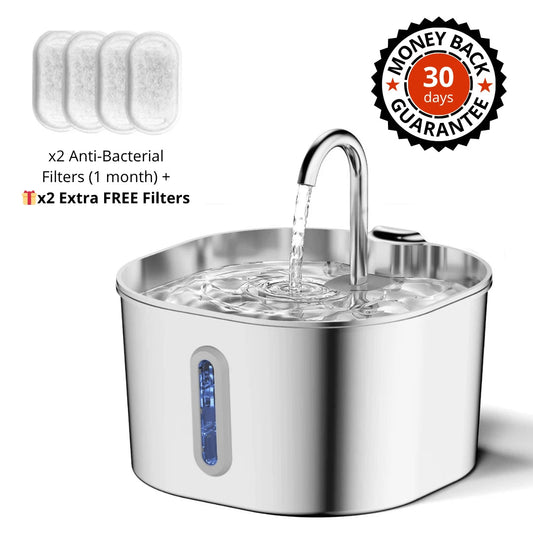
We sell one, so treat this as disclosure rather than a recommendation. Ziveko's stainless steel cat water fountain is 304 food-grade stainless steel, dishwasher safe, with a removable pump and a four-stage filter stack whose bottom layer is a coarse sponge placed specifically to stop hair and debris before they reach the pump. It has a window on the side so you can see the water level without lifting the lid, which sounds trivial and is the reason a fountain gets refilled on time.
What it is not is a solution to a cat that is not drinking enough. Nothing on this page changes because we sell one: if your vet wants your cat's water intake up, the fountain is the least evidence-backed thing on the list, and wet food is the first.
So, is a cat water fountain worth it?
Buy one if your cat already shows an interest in moving water — drinking from the tap, pawing at a glass, ignoring a full bowl next to a dripping sink. That cat is one of the individuals the studies picked up, and for that cat a fountain is genuinely better than a bowl. Buy one, too, if the honest reason is that you would rather refill a large reservoir occasionally than a bowl twice a day. That is a convenience purchase and it is a perfectly good one.
Skip it if you are buying it because a cat is not drinking enough. The evidence says it will probably not fix that, and the two things that might — wet food and more water stations — cost less. And if you do buy one, add it to what you have instead of replacing it, and give the cat a fortnight before deciding it was a waste.
A fountain is a piece of household equipment for the cat, in the same category as the litter tray and the enrichment that keeps an indoor cat occupied. It also belongs to the same family as everything else you leave running while the cat is on its own, and that family has a consistent trade-off we set out in interactive versus automated cat toys: a device buys you availability, never engagement. Worth getting right, not worth expecting miracles from.
Frequently Asked Questions
Do cats really need a water fountain?
No. Cats need reliable access to fresh water, and a bowl provides that. Three controlled studies found no average increase in water intake from a fountain, although individual cats can have strong preferences in either direction.
Do water fountains make cats drink more?
Not on average. A 2010 study in owners' homes concluded that a fountain failed to substantially increase water intake or dilute urine, and a 2019 crossover trial found no appreciable effect of bowl type. Urine concentration has one everyday consequence beyond the medical ones, since more concentrated urine carries more of the raw material bacteria convert into ammonia, which is where what actually removes litter box smell begins. A 2026 review of 32 papers reported that intake was not affected by the mode of water delivery.
How much water should a cat drink a day?
Cornell's Feline Health Center gives about 4 ounces per five pounds of lean body weight, so roughly one cup a day for a 10-pound cat. Measured intakes across studies range from 23 to 51 mL per kg, and cats on wet food drink less because up to 80% of their water comes from the food.
Why won't my cat drink from the water fountain?
Most often placement rather than the fountain: too close to the food, in a room another cat guards, or somewhere the cat feels exposed. Give it two weeks alongside the old bowl rather than replacing the bowl, and listen for a pump that has changed pitch.
How often should you clean a cat water fountain and change the filter?
Most makers recommend a monthly filter change and regular cleaning of the pump itself, which is where hair collects. Cleaning the pump matters more than cleaning the bowl: a blocked impeller is the most common reason a working fountain stops flowing.